
Living with Ehlers-Danlos Syndrome: Adaptive Strategies for Joint Stability
David's Life with Ehlers-Danlos Syndrome: Finding Stability in Laredo
David Torres, a 38-year-old teacher from Laredo, Texas, didn't receive his Ehlers-Danlos Syndrome (EDS) diagnosis until age 32, despite experiencing symptoms throughout his entire life. "I was always the 'hyper-flexible' kid in school in Laredo," he recalls. "Teachers would ask me to demonstrate flexibility during PE classes. Nobody realized I had a genetic connective tissue disorder." For most of his early adulthood, David suffered from recurring injuries, chronic pain, and a sense of frustration that accumulated throughout Webb County medical systems until he finally found answers.
Today, living in South Texas with EDS requires constant awareness and adaptation, but David has developed sophisticated strategies for maintaining joint stability while teaching full-time in Laredo's schools. His story illustrates both the challenges faced by the Hispanic and broader Laredo community living with rare genetic conditions and the practical, evidence-based approaches that make life manageable and fulfilling.
Understanding Ehlers-Danlos Syndrome in the South Texas Context
What Is EDS and Why Diagnosis Matters in Laredo
Ehlers-Danlos Syndrome is a group of genetic disorders affecting connective tissue throughout the body—the structures that provide support and strength to skin, joints, blood vessels, and organs. The classical presentation of EDS involves hypermobility (excessive joint flexibility), skin fragility, and poor wound healing. However, the condition presents differently in each person, making diagnosis particularly challenging in underserved communities like parts of Webb County.
"When I finally got my EDS diagnosis in Laredo, it felt like someone finally took my pain seriously," David explains. "Before that, doctors in South Texas would say, 'Well, you're flexible, so your pain must be from bad posture' or 'You're anxious.' Nobody connected my symptoms to a real genetic condition." The delayed diagnosis common among EDS patients in Laredo and throughout Webb County often results in years of inappropriate treatment, unnecessary procedures, and psychological distress.
The Laredo Experience: Living with EDS Symptoms
For David, EDS affects nearly every aspect of daily life in Laredo. His joints subluxate (partially dislocate) unpredictably—sometimes while simply walking to his classroom, other times during innocuous movements that wouldn't injure a person without EDS. "I've dislocated my shoulder reaching for a book on a shelf in my Laredo apartment," he notes. "I've had my knee slide out of place while descending stairs at my school. The unpredictability is almost harder than the pain itself."
Beyond joint instability, David experiences chronic pain throughout his body—particularly in his neck, shoulders, lower back, and knees. "The pain in Laredo is something I've learned to coexist with rather than eliminate," he explains. "It ranges from 2-3 out of 10 on quiet days to 7-8 after teaching a full day on my feet." This chronic pain pattern is typical for people with EDS throughout South Texas, where providers increasingly recognize the need for specialized management strategies.
The Journey to Diagnosis and Specialized Care in Laredo
Years of Misdiagnosis
David's path to diagnosis was frustratingly typical of EDS patients in Webb County. Throughout his teens and twenties, he accumulated diagnoses of various conditions: anxiety, fibromyalgia, sports injuries, and psychogenic pain. "I saw orthopedic surgeons in Laredo who said my flexibility was just 'good genetics,'" he recalls. "They never investigated why I was having so many injuries despite not being particularly athletic or doing anything dangerous." When he sought care at pain clinics in South Texas, providers often attributed his symptoms to poor conditioning or psychological factors rather than recognizing the underlying connective tissue disorder.
The psychological toll of years of invalidation affected David deeply. "When multiple doctors in Laredo tell you nothing is wrong, you start believing maybe it is all in your head," he admits. "I questioned my own experience of pain. It wasn't until a rheumatologist visiting Laredo from a major medical center identified my EDS characteristics that things finally made sense." Family members in the Laredo area subsequently discovered they also had EDS, suggesting a heritable pattern David hadn't previously recognized.
Building a Specialized Care Team in South Texas
Once diagnosed, David began seeking specialized providers experienced with EDS throughout South Texas. "Laredo doesn't have EDS specialists, obviously," he notes pragmatically. "But my pain management doctor here has educated himself extensively about EDS through literature and conferences. That willingness to learn made all the difference." Building an effective care team in Webb County required coordination with specialists in San Antonio and Corpus Christi while maintaining primary pain management in Laredo.
David's current care team includes a rheumatologist for systemic EDS management, a pain specialist in Laredo experienced with hypermobility disorders, a physical therapist who specializes in EDS, and a primary care physician who coordinates communication. "Having providers who understand that EDS pain is real, not psychogenic, changes everything about your treatment," he explains. The cultural values within Laredo's Hispanic community—which prioritizes family involvement and direct communication—actually enhanced David's care coordination when he involved family members in his medical appointments.
Adaptive Strategies for Joint Stability: David's Practical Approaches
Bracing and External Support Systems
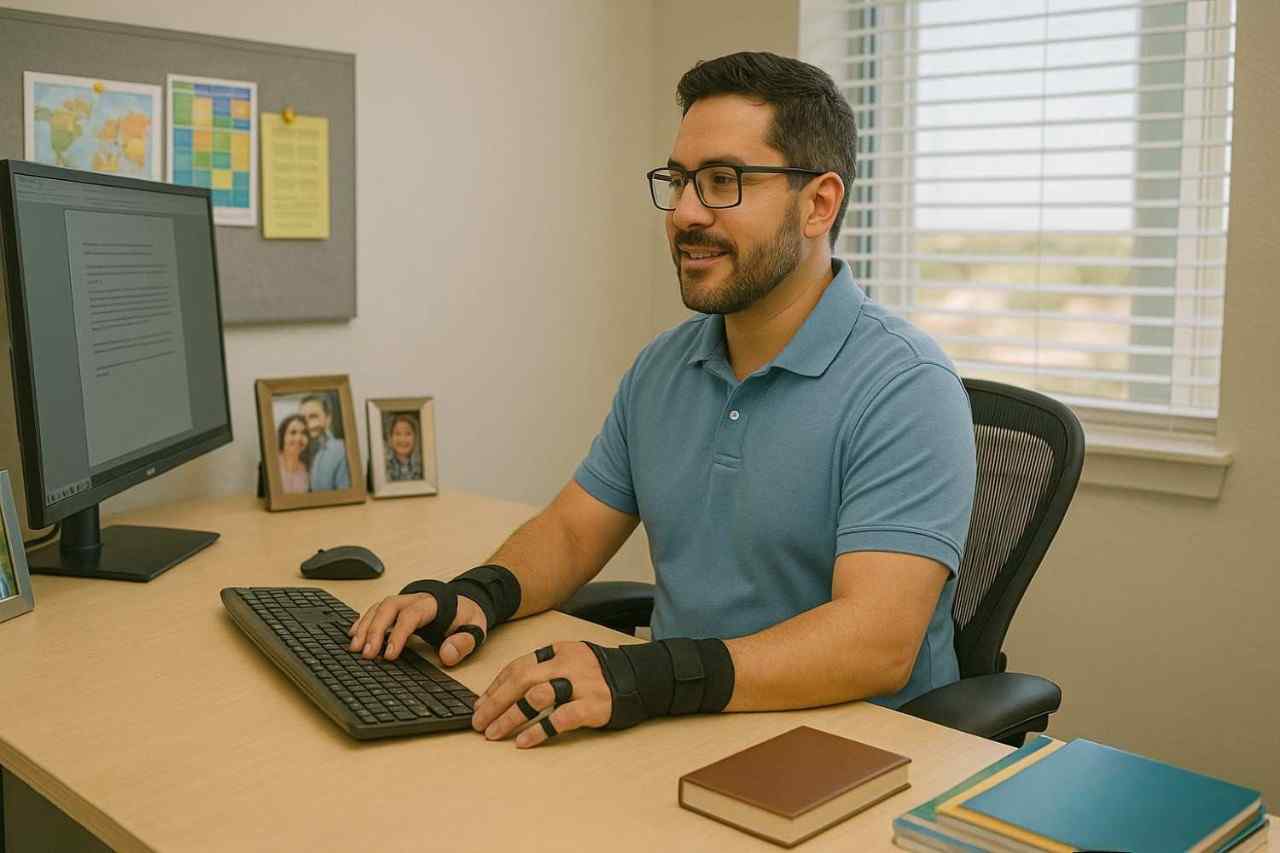
The cornerstone of David's stability strategy involves strategic use of braces and support devices designed specifically for hypermobility disorders. "I wear ankle braces under my pants most days," he explains while showing his collection of supports. "I have wrist braces for grading papers, a knee brace for my unstable knee, and I use a neck collar during high-pain periods." These aren't temporary supports for acute injuries—they're permanent components of David's daily life in Laredo.
- Lower extremity support: Custom ankle-foot orthoses (AFOs) that provide proprioceptive feedback and prevent excessive ankle motion during walking; compression socks throughout the day for circulation and joint stability
- Knee stability: A specialized hinged knee brace worn particularly during physically demanding school days, preventing hyperextension and subluxation during dynamic movements
- Spinal support: A semi-rigid lumbar support corset worn during teaching hours to maintain core stability and reduce lower back strain from sustained standing
- Upper extremity support: Wrist braces with thumb support for functional tasks like writing and grading; shoulder compression when managing shoulder subluxations
- Proprioceptive aids: Kinesiology tape applied therapeutically to provide neuromuscular feedback about joint position during vulnerable movements
Physical Therapy and Strengthening Protocols
Contrary to common advice for hypermobility disorders, David engages in progressive, controlled strengthening rather than stretching. "People assume EDS means I should avoid strength training," he notes. "Actually, developing strength in the muscles supporting my joints is one of the most important protective factors I have in Laredo." His physical therapy in South Texas focuses on proprioceptive training, controlled isotonic strengthening, and neuromuscular stability exercises—different from standard physical therapy.
David's typical weekly program includes three sessions at his Laredo physical therapy clinic focused on:
- Proprioceptive training using balance boards, perturbation training, and unstable surfaces to improve neuromuscular feedback about joint position
- Isometric strengthening exercises that build muscular support without excessive joint movement
- Scapular stability work to prevent shoulder subluxations during reaching and overhead activities
- Core stabilization training to support his lumbar spine throughout his teaching day in Laredo
- Controlled cardiovascular activity on stationary equipment that minimizes unpredictable joint movements
Activity Modification and Lifestyle Strategies
Living successfully with EDS in Laredo requires profound awareness of how daily activities affect joint stability. David has systematically modified his environment and routines throughout his home and workplace. "I used to push through pain and just deal with increased dislocations and inflammation," he recalls. "Now I recognize that small modifications prevent much larger problems."
Practical modifications David has implemented in Laredo include:
- Workplace modifications: Ergonomic classroom setup with a high stool instead of standing all day; use of visual aids and presentations to minimize repetitive writing on boards; structured breaks to move and adjust positions
- Home adaptations: Raised toilet seats, grab bars, lever-style door handles, and organized storage to minimize reaching; a supportive mattress and strategic pillows for sleeping in his Laredo apartment
- Activity selection: Choosing activities compatible with EDS—aquatic exercise in Webb County pools where buoyancy reduces joint loading; stationary cycling instead of running; controlled strength training instead of contact sports
- Pacing strategies: Distributing physically demanding activities throughout the week rather than accumulating them; taking breaks between activities to prevent cumulative fatigue and instability
- Pain management techniques: Heat therapy before activity to reduce stiffness; ice after activity to manage inflammation; scheduled rest periods during high-demand days at his school in Laredo
Medical Management and Pain Control in South Texas
Medication Approach for EDS Pain
David's pain management in Laredo emphasizes non-opioid approaches specifically chosen for their safety profile in EDS patients, where certain medications can worsen tissue fragility or interfere with healing. His current regimen includes:
- Non-steroidal anti-inflammatory drugs (NSAIDs) used judiciously to manage inflammation without overuse that could mask injuries
- Gabapentin for neuropathic pain components related to nerve compression from joint subluxations
- Muscle relaxants used strategically before physical therapy to facilitate participation and after high-activity days to manage spasm
- Topical analgesics applied to particularly painful joints or regions experiencing increased instability
"My pain doctor in Laredo understands that with EDS, we're very careful about medication interactions and side effects," David explains. "Some medications used routinely in pain management could interfere with healing in my connective tissue. That specialized knowledge is crucial."
Interventional Procedures and Their Role
EDS patients in South Texas often avoid interventional procedures due to concerns about tissue fragility and poor healing. However, David has carefully used targeted injections to manage regional pain flare-ups. "My pain specialist in Laredo uses ultrasound guidance to position injections very precisely, minimizing trauma to my tissues," he notes. Over two years, David has received perhaps 4-5 carefully selected injections—far fewer than typical pain patients would receive, reflecting the conservative approach necessary in Webb County for EDS management.
Current Life and Ongoing Management
Four years after his EDS diagnosis and three years into his specialized care journey in Laredo, David maintains an active, fulfilling life as a full-time educator in Webb County. "I'm not going to say EDS doesn't affect me daily—it absolutely does," he states honestly. "But I've developed a sophisticated system for managing it that allows me to do what I love."
His daily reality in Laredo involves:
- Morning routines including appropriate bracing, warm-up exercises, and anti-inflammatory medication before beginning his school day
- Classroom adaptations that allow full engagement with students while protecting his joints
- Scheduled breaks for movement, position changes, and brief ice or heat therapy during his teaching day
- Evening routines including therapeutic strengthening exercises, stretching within appropriate limits, and recovery techniques
- Ongoing specialist appointments and physical therapy maintenance at his Laredo clinic
- Regular reassessment and modification of strategies based on emerging challenges or opportunities
Key Insights for EDS Patients in Webb County
David's experience living successfully with EDS in Laredo and South Texas highlights several crucial insights for other people with this condition throughout Webb County:
- Diagnosis is transformative: Even though EDS cannot be cured, having a correct diagnosis allows appropriate treatment strategies rather than pursuing ineffective approaches for years
- Providers can learn: While specialized EDS expertise is limited in Laredo, pain specialists and therapists willing to educate themselves can provide excellent, individualized care in South Texas
- Strengthening is essential: Contrary to initial instincts, progressive controlled strengthening is one of the most important protective factors for EDS patients throughout Webb County
- Lifestyle modification prevents crisis: Small daily modifications in Laredo prevent larger problems and cumulative damage, making life more stable and predictable
- Interdisciplinary care is necessary: EDS patients in South Texas require coordination among rheumatology, pain management, physical therapy, and primary care for optimal outcomes
- Hope and function are possible: While EDS is lifelong, many patients in Laredo and throughout South Texas live active, engaged lives with appropriate management strategies
For others in Laredo and Webb County recently diagnosed with Ehlers-Danlos Syndrome or struggling with undiagnosed hypermobility, David's message is encouraging: "This condition is real, your symptoms are valid, and there are effective strategies for living well in Laredo. It takes time to build the right system, but you can absolutely have a full, active life with EDS while living in South Texas."