
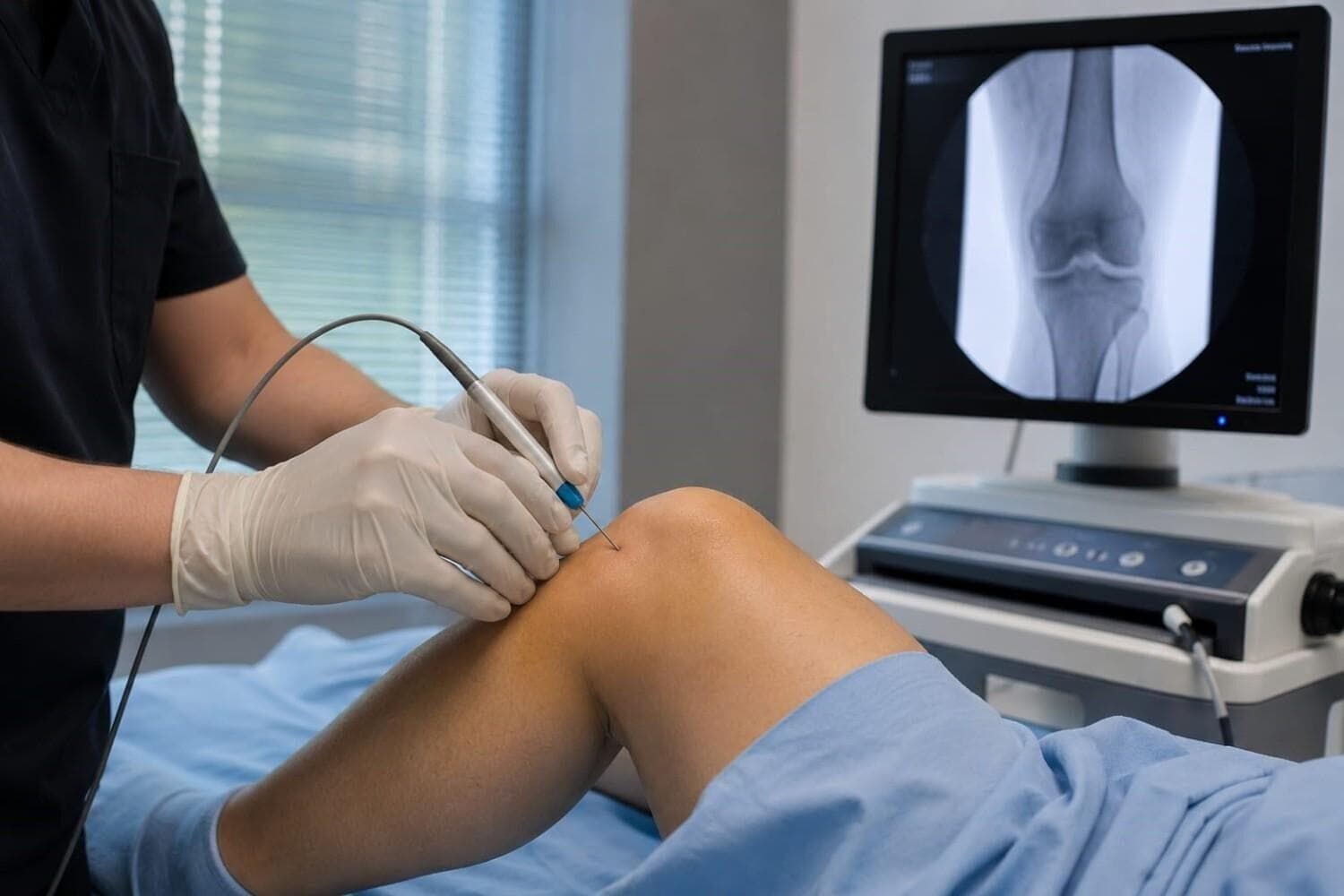
Radiofrequency Ablation Knee Pain
Radiofrequency ablation (RFA) for knee pain works by using heat energy to interrupt the nerve signals that carry pain from your knee to your brain — without surgery, without a hospital stay, and often with relief lasting 6 to 18 months or longer. For Laredo patients managing chronic knee pain who haven't found lasting relief through medications or injections, RFA offers a clinically proven, outpatient alternative worth understanding in detail.
What Is Radiofrequency Ablation and How Does It Target Knee Pain?
Chronic knee pain rarely comes from a single source. Whether you're dealing with osteoarthritis, post-surgical knee pain, or degenerative joint disease, the discomfort you feel travels through a network of sensory nerves — specifically the genicular nerves — that surround the knee joint. Radiofrequency ablation targets these nerves directly.
During the procedure, a board-certified pain specialist uses fluoroscopic (X-ray) or ultrasound guidance to precisely position thin needle electrodes near the genicular nerves. Once confirmed in the correct location, radiofrequency energy heats the needle tip to a controlled temperature — typically between 60°C and 80°C — creating a small lesion on the nerve. That lesion disrupts the nerve's ability to transmit pain signals.
The result is not numbness or paralysis. The genicular nerves are purely sensory nerves responsible for carrying pain signals, not motor nerves that control muscle movement. Your knee's function, strength, and stability remain intact. What changes is the pain signal itself.
There are two main variations used in clinical practice:
Conventional RFA uses continuous heat to create a thermal lesion. This is the most established technique with the longest clinical track record.
Cooled RFA circulates water through the electrode tip to prevent overheating, allowing for a larger lesion area while protecting surrounding tissue. Research, including a landmark multicenter trial published in Pain Medicine, has shown cooled RFA to produce significant and durable pain relief in knee osteoarthritis patients — with many maintaining meaningful improvement at 12 months.
Pulsed RFA delivers short bursts of radiofrequency energy rather than continuous heat, generating less thermal damage. It's sometimes considered for patients where conventional RFA carries higher risk, though evidence for knee applications is still developing.
Understanding which type is appropriate for your specific anatomy and pain pattern is part of what a thorough evaluation with a pain specialist provides.
Why Outpatient RFA Is a Practical Option for Laredo Patients
As Dr. Rehan Memon often hears from patients at Pain Management of Laredo, one of the most consistent concerns is this: "I can't afford to be off my feet for weeks." Between work schedules, family responsibilities, and the general pace of life in our community, a procedure that requires hospitalization or extended recovery isn't realistic for many people.
Genicular nerve RFA checks several practical boxes that matter to Laredo patients specifically.
No hospital admission required. The procedure is performed in an outpatient setting. You arrive, receive local anesthesia (and mild sedation if needed for comfort), and go home the same day — typically within a few hours of arrival.
Minimal recovery disruption. Most patients return to light daily activities within 24 to 72 hours. There's usually some temporary soreness at the needle insertion sites, which resolves quickly. This is not a procedure that puts you in a recliner for a month.
No general anesthesia. Because the procedure uses local anesthesia with optional light sedation, you avoid the risks and extended recovery associated with general anesthesia. Patients who are poor surgical candidates due to cardiovascular or pulmonary conditions often tolerate RFA very well.
Repeatable when needed. Nerves regenerate over time, which means pain can gradually return after 6 to 18 months as the treated nerve recovers. When that happens, the procedure can be safely repeated. This repeatability is a meaningful advantage over surgical interventions, which carry cumulative risk with revision procedures.
Works alongside other treatments. RFA doesn't replace physical therapy, weight management, or other components of a comprehensive pain plan — it complements them. When pain is significantly reduced, patients are often better able to engage with advanced physical therapy techniques that would otherwise be too uncomfortable to tolerate consistently.
For patients who have been told they're not yet ready for knee replacement, or who want to delay surgery as long as possible, genicular nerve RFA can extend a meaningful quality of life window — sometimes by years.
Who Is a Good Candidate for Radiofrequency Ablation Knee Pain Treatment?
Not every patient with knee pain is an ideal candidate for RFA, and a careful evaluation matters. At Pain Management of Laredo, the process typically involves a detailed history, physical examination, and a diagnostic nerve block before proceeding.
The diagnostic nerve block step is important. Before performing RFA, a pain specialist will often inject a small amount of local anesthetic near the genicular nerves. If you experience significant temporary pain relief from that block — typically 50% or greater reduction — it confirms that those nerves are meaningful contributors to your pain and that RFA is likely to be effective. Patients who don't respond to the diagnostic block are less likely to benefit from ablation.
Conditions commonly treated with genicular nerve RFA include:
Knee osteoarthritis (mild to severe)
Chronic knee pain following total or partial knee replacement
Chronic knee pain after ACL, meniscus, or other orthopedic procedures
Knee pain from degenerative joint disease in patients who are not surgical candidates
Factors that may affect candidacy:
Active infection near the procedure site
Bleeding disorders or anticoagulation therapy that cannot be safely paused
Implanted electrical devices (like pacemakers) — requires specialist coordination
Unrealistic expectations about outcomes — RFA reduces pain; it does not repair structural damage to cartilage or bone
A thorough conversation with your pain specialist about your goals, your imaging findings, and your overall health picture is the foundation of a good outcome — something Dr. Rehan Memon emphasizes during every patient evaluation at Pain Management of Laredo.
How Does RFA Compare to Other Knee Pain Interventions?
Understanding where RFA fits in the broader landscape of other interventional pain procedures helps patients make informed decisions rather than simply accepting whatever is offered next.
Corticosteroid injections are often a first-line intervention for knee pain and can provide meaningful short-term relief — typically 4 to 12 weeks. They're appropriate early in treatment but carry cumulative risks with repeated use, including potential cartilage degradation over time. RFA is generally considered after injections have provided insufficient or short-lived relief.
Hyaluronic acid (viscosupplementation) injections lubricate the joint and may help some patients with mild to moderate osteoarthritis, though evidence for their effectiveness is mixed. Like corticosteroids, they address the joint environment rather than the pain pathway itself.
Platelet-rich plasma (PRP) is an emerging regenerative approach with growing evidence, particularly for early-to-moderate osteoarthritis. PRP and RFA can sometimes be used together — PRP targeting the joint's biological environment, RFA addressing the pain signal.
Knee replacement surgery remains the definitive intervention for severe osteoarthritis with significant structural damage. However, not every patient with knee pain is a surgical candidate, and up to 20% of patients report persistent pain following knee replacement. For this group, genicular nerve RFA has emerged as an important treatment option for post-surgical knee pain.
RFA occupies a meaningful middle ground: more durable than injections, less invasive than surgery, and repeatable when the nerves regenerate. For the right patient, it's not a last resort — it's a strategically appropriate step in a well-designed pain management plan.
The way we approach chronic knee pain mirrors how we approach conditions like multimodal care for CRPS — layered, individualized, and focused on restoring function alongside reducing pain.
What to Expect Before, During, and After the Procedure
Before: You'll have a consultation to review your history, imaging, and prior treatments. If appropriate, a diagnostic nerve block will be scheduled first. You'll receive specific instructions about medications — particularly blood thinners — and fasting requirements if sedation is planned.
During: The procedure typically takes 30 to 60 minutes. You'll be positioned on a procedure table, and the skin over the knee will be cleaned and numbed with local anesthetic. Using imaging guidance, the physician precisely positions the electrodes near the target nerves. You may feel mild pressure or brief warmth during the energy delivery. Most patients tolerate the procedure comfortably.
After: You'll be monitored briefly before discharge. A responsible adult should drive you home if sedation was used. Expect some soreness at the needle sites for a few days — this is normal and manageable with ice and over-the-counter pain relievers. Significant pain reduction typically begins within 1 to 3 weeks as the nerve lesion stabilizes, though some patients notice improvement sooner.
You'll have a follow-up appointment to assess your response and adjust your overall care plan accordingly. As research in pain medicine continues to evolve — including future gene editing breakthroughs that may eventually change how we treat chronic pain at its root — procedures like RFA represent the current standard of evidence-based, minimally invasive care.
FAQ
How long does radiofrequency ablation for knee pain last?
Most patients experience meaningful pain relief for 6 to 18 months following genicular nerve RFA. Individual results vary based on the technique used, the extent of nerve involvement, and patient-specific factors. Because the treated nerves can regenerate over time, pain may gradually return — at which point the procedure can be safely repeated.
Is radiofrequency ablation for knee pain covered by insurance?
Many insurance plans, including Medicare, cover genicular nerve RFA for knee osteoarthritis when specific criteria are met — typically including documented failed conservative treatments and a positive diagnostic nerve block. Coverage policies vary by plan and payer. The team at Pain Management of Laredo can assist in verifying your benefits before scheduling.
Will I be able to walk after radiofrequency ablation knee pain treatment?
Yes. Most patients walk out of the procedure the same day and return to light daily activities within 24 to 72 hours. RFA targets sensory nerves only and does not affect the motor nerves that control muscle movement or knee stability. Some temporary soreness at the needle sites is normal and typically resolves within a few days.
How is genicular nerve RFA different from a regular knee injection?
A knee injection — whether corticosteroid, hyaluronic acid, or PRP — delivers medication into or around the joint to reduce inflammation or improve joint environment. RFA works differently: it uses heat to interrupt the nerve pathway carrying pain signals from the knee to the brain. The effects of RFA typically last significantly longer than most injections and work independently of the joint's internal condition.
Can I have RFA if I've already had knee replacement surgery?
Yes. Genicular nerve RFA is an established treatment for persistent pain following total or partial knee replacement. It's one of the few evidence-supported options for patients who continue to experience significant pain after surgery, and it can be performed without interfering with the implant itself.