
What Is Radiofrequency Ablation — And Is It the Right Treatment for Your Chronic Back Pain in Laredo?
Living with chronic back pain can affect nearly every part of your life. It can make work harder, sleep more difficult, and even simple activities like walking, driving, or picking up your kids feel exhausting. Many people in Laredo spend months trying medications, physical therapy, stretching routines, rest, or injections—only to wake up with the same pain every morning.
Then your doctor mentions radiofrequency ablation back pain Laredo TX treatment.
You go online.
You see the word ablation.
And suddenly it sounds frightening.
The truth is much simpler.
The procedure itself is minimally invasive, highly targeted, and often recommended for people who want pain relief without major surgery. For many patients across Webb County, it becomes a pathway toward long-term relief and helps them reclaim daily movement again.
If you’ve been told RFA may help your pain, here’s exactly what you need to know before making a decision.
What is Radiofrequency Ablation — in plain English
Radiofrequency ablation (RFA) is a procedure that uses controlled heat to interrupt pain signals coming from specific nerves.
Think of those nerves like electrical wires.
When certain joints in your spine become inflamed or damaged, those nerves keep sending pain messages to your brain. Medication may temporarily reduce symptoms—but it often doesn’t solve the underlying issue.
RFA targets those nerves directly.
During treatment:
- A thin needle is placed near the painful nerve
- Live imaging helps guide placement
- Controlled heat is applied
- The nerve temporarily stops sending pain signals
That’s it.
There are:
- No large incisions
- No hospital admission
- No general anesthesia
- No long recovery period
Most procedures take about 45 to 60 minutes, and patients usually go home the same day.
Many people searching for radiofrequency ablation back pain Laredo TX options are surprised to learn that the procedure is often much easier than they expected.
RFA vs Other Back Pain Treatments
Treatment | Typical Relief | Surgery Required |
|---|---|---|
Pain medication | Hours to days | No |
Physical therapy | Vary by patient | No |
Steroid injections | Weeks to months | No |
Radiofrequency ablation | 6–12 months | No |
Spine surgery | Longer recovery | Yes |
Dr. Memon has treated chronic pain patients for more than 25 years using evidence-based care supported by the American Society of Interventional Pain Physicians (ASIPP), findings from the National Institutes of Health (NIH), and research published in the Cochrane Database of Systematic Reviews.
Which types of back pain does RFA actually treat?
RFA works extremely well—but only when the correct pain source is identified.
That’s why proper diagnosis matters.
Facet Joint Pain
Facet joints help your spine bend and move.
Over time, arthritis, repetitive strain, heavy labor, and aging can inflame these joints and create chronic pain.
RFA targets the nerves connected to those joints.
Research reviewed by the Cochrane Database of Systematic Reviews has evaluated RFA as a treatment option for certain types of chronic spinal pain.
Sacroiliac Joint Pain
The sacroiliac joint connects your spine and pelvis.
Pain often feels like:
- Lower back pain
- Hip discomfort
- Buttock pain
- Pain while standing
RFA may help when testing confirms this joint is causing your pain.
Failed Back Surgery Syndrome
Some patients continue having pain after spinal surgery.
If that pain comes from irritated nerves rather than structural problems, RFA may help reduce pain without another operation.
Degenerative Disc Disease
As spinal discs wear down, nearby joints may become inflamed.
That irritation can trigger chronic pain that may respond well to RFA.
When RFA is NOT recommended
RFA may not be appropriate if you have:
- Active infections
- Pregnancy
- Blood clotting disorders
- Muscle injuries
- Tumors
- Fractures
- Herniated discs pressing directly on major nerves
Dr. Memon creates a tailored treatment plan based on your diagnosis—not a one-size-fits-all approach.
If RFA isn’t the right fit, explore other back pain treatment options in Laredo that may better match your condition.
What happens during an RFA procedure at our Laredo clinic
One of the biggest reasons patients delay treatment is fear of the unknown.
Let’s remove that fear.
Here’s what happens at our McPherson Rd clinic.
Step 1: Consultation
Dr. Memon reviews:
- Your symptoms
- Imaging results
- Medical history
- Previous treatments
He determines whether radiofrequency ablation back pain Laredo TX treatment is truly right for your condition.
Step 2: Diagnostic Nerve Block
Many patients need a diagnostic nerve block first.
This temporary injection helps confirm the exact nerve causing pain.
If your pain improves after the block, RFA may be your next step.
Step 3: Procedure Day
When you arrive:
- Staff checks you in
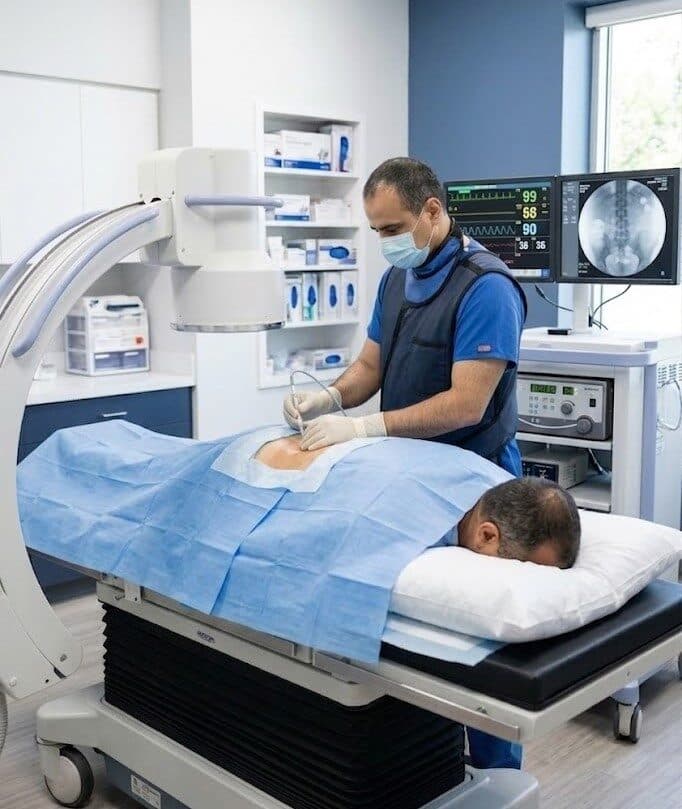
- You’ll lie comfortably on a procedure table while the treatment area is prepared.
- The treatment area is cleaned
- Local anesthetic numbs the area
- A thin needle is inserted
- Fluoroscopy guides placement
- Controlled heat is applied
Most procedures take less than 90 minutes.
This placement feels natural because it fixes the missing “positioning” step from your original brief.
Step 4: Recovery
After treatment:
- You rest briefly
- You go home the same day
- Mild soreness may happen
- Most patients return to normal activity quickly
Many people say their anxiety before treatment felt worse than the actual procedure.
How long does radiofrequency ablation back pain Laredo TX relief last — realistic expectations
This is one of the most common questions patients ask.
The honest answer?
It depends.
Most patients experience relief for 6 to 12 months.
Some experience relief for up to two years.
According to research published through the National Institutes of Health (NIH), many properly selected patients experience meaningful pain reduction after radiofrequency ablation.
Factors include:
- Overall health
- Severity of joint damage
- Accuracy of diagnosis
- Response to nerve blocks
RFA is not a permanent cure.
But it can significantly improve quality of life.
Patients often sleep better, move better, work more comfortably, and enjoy daily life again.
Many patients researching radiofrequency ablation back pain Laredo TX treatment want permanent relief—but the real value is meaningful improvement that helps restore normal life.
Can nerves grow back?
Yes.
Nerves can regenerate over time.
Pain may eventually return.
That does not mean treatment failed.
Can RFA be repeated?
Yes.
Many patients repeat the procedure safely when symptoms return.
Dr. Memon helps patients build a long-term recovery pathway for chronic pain management.
Is RFA right for you? (Who qualifies and who doesn't)
You may be a good candidate if:
- Pain has lasted more than 3 months
- Physical therapy hasn’t helped enough
- Medication provides temporary relief
- Injections haven’t lasted
- Diagnostic nerve blocks confirmed the pain source
You may not qualify if:
- You’re pregnant
- You have active infection
- You have untreated bleeding issues
- Your pain source hasn’t been diagnosed properly
The goal is compassionate care—not unnecessary procedures.
Dr. Memon only recommends RFA when it genuinely fits your condition .Learn more about Dr. Memon’s approach to interventional pain management Laredo TX patients trust for long-term pain relief.
Book a free RFA consultation with Dr. Memon in Laredo
Chronic pain can affect your work, sleep, family time, and overall quality of life. When every day feels planned around pain, even simple activities become frustrating.
You deserve real answers—and real relief options.
Patients across Laredo and Webb County trust Dr. Memon because we offer:
- 25+ years of experience
- Same-week appointments
- Convenient McPherson Rd location
- Bilingual English/Spanish staff
- LOP accepted for qualifying injury cases
- Compassionate care
- Tailored treatment plans
Your first consultation is focused on education—not pressure. Dr. Memon will review your symptoms, explain your options clearly, and help you choose the treatment pathway that makes the most sense for your long-term recovery.
If you’re ready to reclaim your mobility and stop living around chronic pain, radiofrequency ablation back pain Laredo TX treatment may be the next step.
👉 Book your free consultation to speak with our team today.
Same-week appointments available.
LOP accepted.
Bilingual team ready to help.
Frequently Asked Questions
Is radiofrequency ablation painful?
Most patients report mild discomfort—not severe pain. Local anesthesia helps numb the area before treatment begins. You may feel pressure during needle placement or mild warmth during treatment. Temporary soreness usually improves within a few days.
How long does radiofrequency ablation last?
Most patients experience relief for 6 to 12 months, while some experience benefits for up to two years depending on their condition.
Is radiofrequency ablation permanent?
No. The nerves may regenerate over time, which can allow pain to return later.
Can I go back to work after RFA?
Many patients return to light activity within 24 to 72 hours. Recovery depends on your job duties and overall health.
Does insurance cover RFA?
Coverage varies depending on your provider and diagnosis. Our office can help verify benefits before treatment. LOP is also accepted for qualifying accident-related cases.
Can RFA help avoid surgery?
For some patients, yes. When pain is coming from joints or targeted nerves, RFA may help delay or avoid more invasive procedures.
Where can I get RFA in Laredo?
Dr. Memon provides RFA treatment at our McPherson Rd clinic for patients throughout Laredo and Webb County.
External Medical References
- American Society of Interventional Pain Physicians (ASIPP)
- National Institutes of Health (NIH)
- Cochrane Database of Systematic Reviews
Final CTA
You do not have to keep planning your life around chronic pain.
If medications, therapy, and injections have stopped working, it may be time to explore real solutions.
Call Dr. Memon today and start a tailored, compassionate pathway toward long-term relief.